
Saluda 72-Hour Release Feed Status
The official Saluda County Detention Center and Sheriff pages did not offer a roster, released-person tab, 72-hour report, or archive when reviewed on August 1, 2026. No public URL, field list, refresh schedule, photo display, or retention promise exists for a county feed. A page elsewhere that uses the county name should not be assumed to be a Sheriff source.
This gap changes the workflow. Begin with the county facility, not an unofficial list. The jail may hold an existing report in its jail-management system even though no public interface exposes it. Asking for a precise three-day record range gives staff a clear target and reduces the risk of mixing current detainees with people whose custody actually ended.
Check Saluda Three-Day Releases
Contact the Saluda County Detention Center at 864-445-0286. Define the range before calling. A rolling 72-hour window should use the same time of day at both ends, while a calendar-based request should identify each date and time zone. If the question concerns one known person, give the full booked name, suitable identity details, and booking number when available.
Follow the wider-window sequence below:
- Fix the start and end timestamps for the full three-day period.
- Ask the detention center whether the person remains in local custody or whether an existing record shows release or transfer.
- Search the Saluda Public Index for orders and events entered during or near the range.
- Check SC VINE for participating-agency custody status and the displayed update context.
- Submit an exact-range request for the existing release report or booking-release records.
For the narrower same-day method, use the Saluda County 24-Hour Releases page. It focuses on a single day rather than the weekend-sized span addressed here.
Saluda Weekend Release Timing
A three-day range is useful because legal action and physical jail release do not always appear at the same moment. A bond order may be entered before paperwork, identity checks, payment processing, transportation, or another hold is resolved. A late Friday event can therefore lead to a later recorded jail departure. Saluda County has not published a weekend or holiday release schedule, so no fixed pickup time should be promised.
Include a small buffer around uncertain dates. Search court events just before and after the window, then use the jail record for the physical release timestamp. Holidays can also affect normal administrative access even when custody operations continue. Call first if planning an in-person inspection. When dates matter, document which source supplied each timestamp instead of merging them into one assumed event.
Note: A three-day query catches more timing variation, but it still requires a county record to prove the precise Saluda jail departure.
Saluda 72-Hour Release Record Fields
No online Saluda release feed establishes what a public 72-hour list would show. Request fields that identify each custody episode and explain how it ended. If the request covers several people, accept lawful redactions and ask for segregable material, meaning nonexempt portions that can be released apart from protected details.
| Field to request | Use in a three-day check |
|---|---|
| Booked name and booking number | Separates people with similar names and ties the row to one jail stay. |
| Admission timestamp | Shows when the recorded county custody episode began. |
| Release timestamp | Places the completed processing inside or outside the exact range. |
| Disposition or release type | May show bond, time served, dismissal, sentence completion, transfer, or another basis. |
| Destination or receiving agency | Distinguishes community release from continued custody elsewhere. |
| Charges, bond, and court numbers | Connects the jail movement with the relevant Saluda court record. |
| Booking photograph, requested separately | Identifies the booking image without holding up other record fields if access is limited. |
The terms are not interchangeable. Bond permits pretrial release under a court's conditions. Time served concerns credited or completed custodial time. A transfer ends the Saluda jail stay but not government custody. A dismissal concerns a charge and does not establish the exact moment all holds cleared. Read the release type with the destination and court case.
File a Saluda Three-Day Request
The Saluda County FOIA policy and form routes requests through the County Council Office at 400 West Highland Street, Saluda, SC 29138. Identify the detention center as the custodian. Ask for an existing document, not a newly made analysis. South Carolina FOIA does not require an agency to create an electronic record that does not exist.
Suggested wording is: “Under the South Carolina Freedom of Information Act, please provide the existing release report or booking-and-release records for people whose Saluda County Detention Center custody ended between [start date and time] and [end date and time]. Please include booked name, booking number, admission and release timestamps, recorded disposition, public destination or receiving agency, charges, bond, and court numbers, with required redactions. Electronic delivery is preferred. Please provide an itemized cost estimate before processing.”
The posted fee schedule lists $11.72 per hour for search or copy labor, $0.25 per paper copy, and actual cost for special reproduction. A deposit may be required up to 25 percent. The policy sets a ten-business-day determination period for current records and twenty business days for records more than 24 months old. Production generally follows within 30 or 35 calendar days after final determination, subject to the policy and any deposit. Confirm current terms before filing.
Inspect Saluda Recent Jail Records
Saluda County's own policy provides a distinctive in-person route. Documents identifying people confined in a jail, detention center, or prison during the preceding three months must be open for public inspection during normal business hours, subject to lawful redaction. That rule can support inspection of an existing recent jail-identification document covering the chosen three days. It still does not turn the document into a web feed.
The detention center lists weekday administrative hours of 8:30 a.m. to 5:00 p.m. Ask what record can be inspected and whether advance scheduling is needed. This route may help when electronic access is absent, though a written copy request may still be needed for a lasting record. The official county facility page is the source for current jail contact information.
Review the official detention-center page before relying on the captured page view.
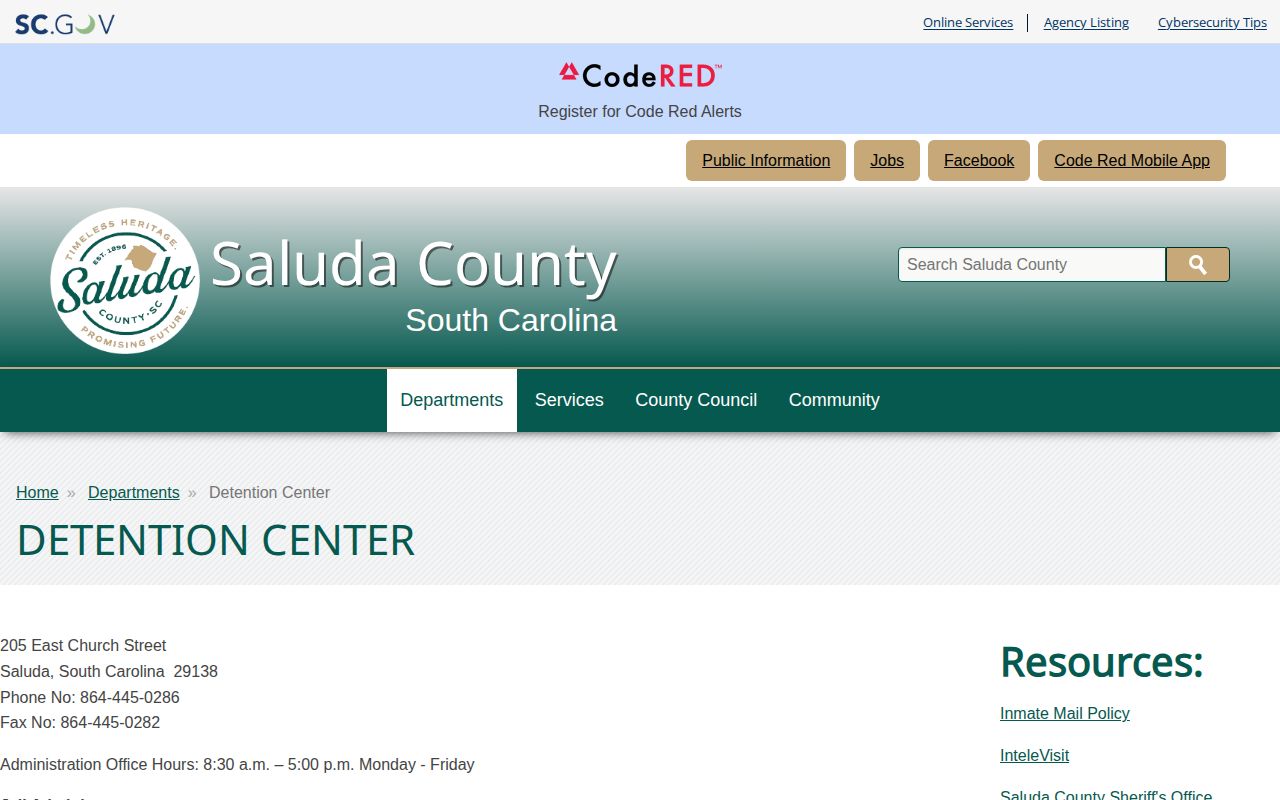
The page identifies the local jail channel, while the requested report supplies the actual three-day release data.
Trace Saluda Releases Across Systems
A departure from Saluda County custody can lead to several paths. A person released to the community should have a county disposition and timestamp. A state commitment moves the person to SCDC, where the current inmate search can establish continuing state custody. The separate SCDC Released Inmate Search uses beginning and ending release dates plus a county selection. Its results concern SCDC release events, not Saluda County jail exits.
- Still in local custody
- The detention center remains the source for current interpretation.
- Released from local custody
- The booking-release record should show the time and recorded basis.
- Transferred to SCDC
- The county stay ended, but state incarceration continued.
- Moved federally or to ICE
- The person may remain in custody even though Saluda's episode closed.
Use the BOP locator for federal custody history and the ICE locator for an eligible immigration-custody inquiry. Neither replaces the Saluda release record. A focused named-person workflow across all custodians appears on the Saluda County released-inmates home page.
Saluda Three-Day Data Limits
No verified Saluda public update cadence or web-retention period exists. VINE's statewide material discusses frequent data collection from participating systems, but that is not a Saluda Sheriff release-feed schedule. A court docket can retain a legal event while a custody status changes. The county's ordinary record may remain available after any transient status display disappears, but no specific public retention term should be promised.
The three-day method reduces one problem, a date range that is too tight. It does not solve identity errors, transfers, sealed records, or update gaps. Match the name with booking or offender identifiers. Save the agency and displayed update time. Then obtain the custodian's existing record when exact proof is needed. That sequence keeps a weekend search grounded in records rather than assumptions.
A range can also cross two kinds of records. Jail entries document admission, movement, and release processing, while court entries document judicial acts such as bond, dismissal, sentencing, or commitment. Neither should be forced to answer the other's question. Compare them by case number and time, then ask the detention center to resolve any gap in the recorded custody path. For several releases, request only fields needed to identify each episode and disposition. For one person, a named booking-and-release request is more focused and can reduce search labor.
Note: Preserve the exact start and end timestamps because “last three days” can mean a rolling window or three calendar dates.