
Saluda County VINE Coverage
South Carolina’s service is SC VINE, short for Victim Information and Notification Everyday. The state describes a network that draws from participating county detention centers, SCDC, and SCDPPPS. It also lists two prison work camps and two city jails within the broader network. The state summary does not name every county participant. Therefore, local coverage should be confirmed by finding a matching Saluda County agency record rather than assuming that all custody events appear.
The SC VINE FAQ documents web, mobile-app, and telephone access. The service is free, supports more than one language, and provides trained help around the clock. The main state number is 1-866-727-2846. Its role is status and notification. It is not a permanent certified archive, and it cannot replace a release sheet from the Saluda County Detention Center or an SCDC custody record.
A county jail record and a state-prison record answer different questions. Someone who leaves the Saluda jail for SCDC has transferred rather than returned to the community. SCDC records then control the prison-custody question. A federal prosecution belongs with the Bureau of Prisons or the federal court record because VINE does not provide the federal historical locator used for BOP releases.
Search Saluda County VINE Records
Begin at the South Carolina VINE portal. Search one adult at a time. Exact name is helpful, but common names require more care. A middle initial, date of birth when lawfully known, or offender number can separate similar results. Open the record only after the agency and identity align.
The portal view below is the official state-selection and person-search entry captured for this project. Source: VINELink.
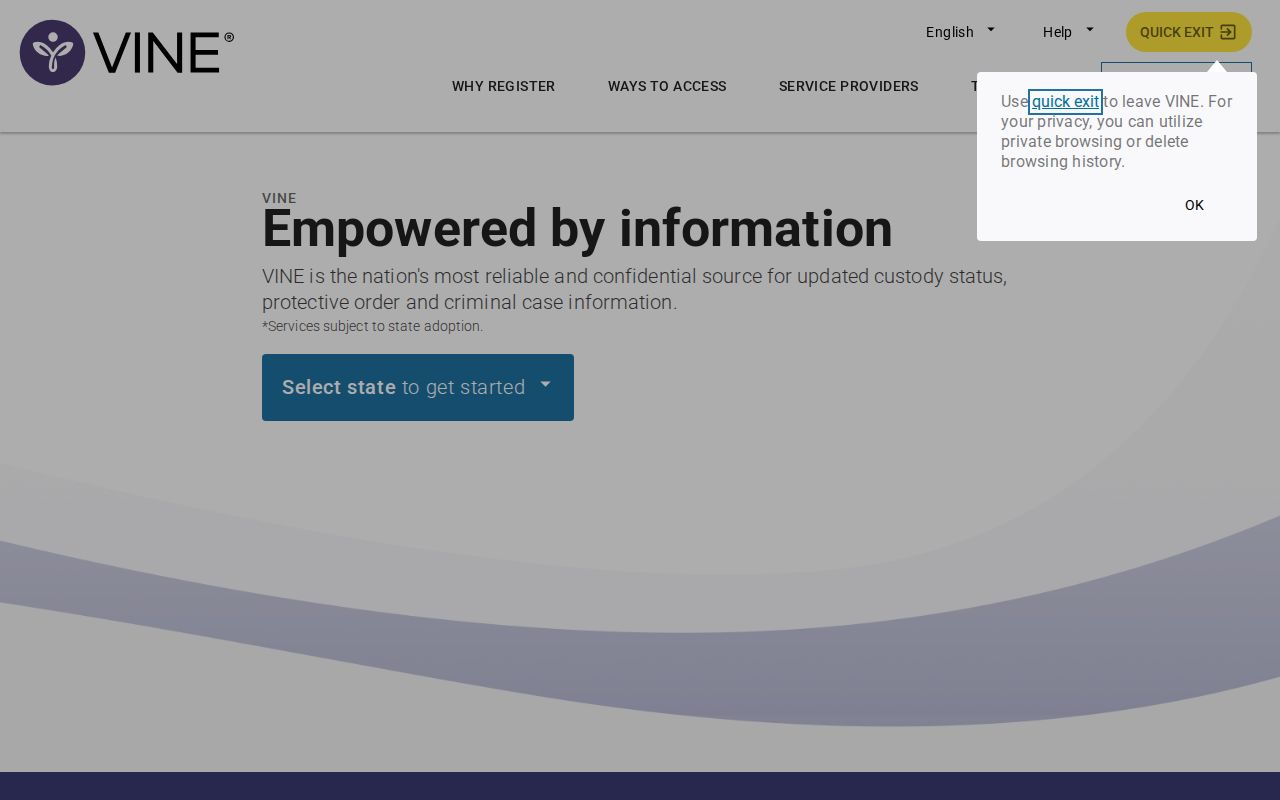
The state choice controls which agencies and records are searched, so confirm South Carolina before entering the person’s details.
- Select South Carolina and accept the portal terms presented for the search.
- Enter the adult’s name, adding a middle initial or identifier when duplicate matches appear.
- Compare the agency, location, offender number, and identity details before opening a result.
- Read the custody status and last-update context together; save both with the agency name.
- If no match appears, try a known spelling or number and check whether another agency received a transfer.
The Saluda County Detention Center remains the direct source for a local release or transfer. Its main number is 864-445-0286. Staff may limit what can be confirmed by phone. A focused booking-and-release record request supplies the durable fallback.
Saluda VINE Release Fields
VINE’s main value is near-real-time status. Available fields can vary by reporting agency and the kind of record. Capture what is actually shown, not what another county displays. The agency and update time are as important as the release word because they explain which system supplied the event and when it reached VINE.
| Field | How to read it |
|---|---|
| Name or offender number | Identity key used to distinguish the correct adult record. |
| Agency | The participating jail, SCDC, or supervision source that sent the status. |
| Location | The reported site or supervising authority, which may change after transfer. |
| Custody status | The source’s current label, such as in custody, released, or out of custody. |
| Update context | The timing attached to the displayed information, useful for spotting possible lag. |
| Notification options | The phone, text, email, or TTY channels offered for that record. |
A “released” or “out of custody” result means the participating source no longer reports that person in the covered custody or has posted a release event. It does not certify release from an agency that never supplied that record. Nor does it rule out a later arrest, an ICE transfer, federal custody, or a move from the Saluda jail to SCDC.
When exact proof matters, save the VINE context and request the custodian’s release record. The Saluda County release-record route explains how court entries, jail records, and SCDC releases fit together for a named person.
Set Saluda VINE Release Alerts
Notification begins only after the correct record is open. Choose the notification control and select from the channels offered for that record. Telephone, SMS text, email, and TTY may be available. Enter and confirm the contact detail with care. A wrong digit or old address can prevent the alert from arriving.
Telephone registration uses a four-digit PIN chosen or assigned during the process. When the automated call arrives, enter that PIN to acknowledge the notice. The state FAQ says calls continue for up to 48 hours or until the PIN is entered. Email and SMS alerts do not use the call PIN. Preserve the confirmation and the agency identifier so the registration can be checked later.
- Open the verified person and agency record, then choose its notification option.
- Select telephone, text, email, or TTY from the channels the record offers.
- Provide the contact detail and complete the confirmation prompts.
- For telephone alerts, keep the four-digit PIN and enter it when the automated call arrives.
- Update contact details when they change, and register again after an interagency transfer.
Registration is described as anonymous and confidential and may be cancelled. It should support, not replace, a personal safety plan or direct agency contact. SCDC directs crime victims who need its specific notification services to SCDC Victim Services at 1-800-835-0304 or 803-896-1733.
Saluda VINE’s Local Notification Layer
Saluda County adds a local navigation point through Victim Services. The county page links to VINE and documents help with case status and justice-system navigation. Its office is at 100 Law Enforcement Drive, Saluda, with telephone 864-445-2112 and fax 864-445-2078. The published contact names advocate Sara Davis at extension 2349. Verify personnel before relying on a named contact.
This local office can help a crime victim understand the notification route and the relevant county process. The South Carolina Attorney General Crime Victim Services Division supplies the broader statewide layer. Neither office is the legal custodian of every release record. The jail records the county custody event, SCDC records a state-prison event, and the court records the case action. Victim Services supplies the documented local link and navigation layer.
SC VINE says participating booking and offender-management data are collected every 15 minutes. That interval describes collection from participating systems, not a promise that every original entry is made at once. Local processing, transmission, and transfer can still cause a gap. For that reason, a safety-sensitive inquiry should pair VINE with direct contact to the agency shown on the record.
Note: The statewide collection interval is not a Saluda County release schedule and cannot predict when a specific event will appear.
Saluda VINE Transfer Checks
A transfer is the most important local trap. The state FAQ instructs users to register again after an interagency move. If a person leaves the Saluda County Detention Center and enters SCDC, the county record may close before the state record becomes the active source. One disappearance and one new registration can represent continuous custody.
Use the last known custodian as the starting point. Call the Saluda jail when the person was booked locally. Check the SCDC current search when a court commitment or transfer is possible. Search the SCDC Released Inmate Search only for a later state-prison release event. For possible immigration custody, use the ICE locator and its assistance channels. For a federal case, use the BOP locator and court docket.
The Saluda Public Index can explain a bond order, sentence, dismissal, or commitment. Yet a court order and physical movement are distinct. An order may authorize release while jail processing continues. Conversely, a jail departure can be a transfer rather than freedom. Match the docket event to the custody record.
Jurisdiction shapes the next call. General Sessions material belongs with the Saluda Clerk of Court, while lower-court and bond matters may be held by Magistrate or Municipal Court. A case entry can supply the legal reason for movement but not the precise time the jail completed it. Record both sources. If VINE changes first, ask the custodian whether the event was release to the community, commitment to SCDC, or transfer to another authority.
Confirm Saluda VINE Release Results
The SC VINE FAQ says no available custody information can be treated operationally as release and notes that adults on bond and out of custody cannot be tracked. A careful Saluda County check treats that as guidance, not final legal proof. No result can also stem from spelling, a new agency record, excluded custody, lack of participation, or timing.
VINE does not display juvenile offenders or track people held in mental-health facilities. It also does not serve as the BOP historical release locator. The service may show community-supervision data from SCDPPPS, but that status differs from physical jail custody. Read the category and source as posted.
For a recent local change, call the detention center and ask whether the person remains in Saluda County custody and whether a recorded departure was community release or transfer. For historical proof, request the named booking-and-release episode, release timestamp, disposition, and destination if public. The Saluda County FOIA form and policy provide the local request route. Ask for an existing record in electronic form and identify the booking episode narrowly. For an SCDC event, preserve the SCDC number and release date, then address any conflict through SCDC’s records or FOIA route.
Older VINE information may no longer be displayed even though the underlying government record remains. Save an alert with its agency and time when it arrives. Then obtain the source record if the exact event must remain available later. This two-source method preserves the speed of notification without treating a changing portal as the final archive.
Note: Save the reporting agency and update time with any alert so a later direct confirmation has clear context.