
Saluda Parole and Probation Compared
Parole and probation can both place a person under rules in the community, yet they begin in different ways. Parole is a conditional release from an eligible prison sentence authorized by the South Carolina Board of Paroles and Pardons. Probation is ordered by a court, often with part of a sentence suspended. A person may also have a category such as community supervision, supervised reentry, tracking, or supervised furlough. Those labels should not be replaced with the broad word “parole.” Each label points to a different legal path and record.
The South Carolina Department of Probation, Parole and Pardon Services, or SCDPPPS, administers these forms of community supervision. Someone who completed a short stay at the Saluda County Detention Center may have no SCDPPPS status at all. By contrast, a person leaving SCDC may move to parole or a statutory form of supervision. The custody record establishes departure from jail or prison. The SCDPPPS record establishes whether rules continue after that departure.
| Category | How it begins | Best verification source |
|---|---|---|
| Parole | The Board conditionally releases an eligible state prisoner. | Board result, then SCDC release and SCDPPPS status |
| Probation | A judge orders supervision, sometimes with a suspended term. | Sentencing order and SCDPPPS |
| Community supervision | South Carolina law requires a period after release for certain sentences. | SCDC release type and SCDPPPS |
| Discharge | The custody or supervision term ends under the controlling record. | Final record from the agency that held the term |
- Parole
- Conditional release from an eligible prison term before its final end.
- Probation
- Court-ordered community supervision that may replace or follow custody.
- Absconder
- A status alleging that a supervised person failed to remain in contact or comply.
- Discharge
- The formal end of a custody or supervision obligation shown by the responsible agency.
Verify Saluda Post-Release Supervision
Start with a firm identity. Exact name, date of birth when lawfully known, SCDC number, and Saluda court case number help separate people with similar names. Next determine the last known authority. A local sentencing order can establish probation. An SCDC record can establish state custody and a later release event. A Board record can establish a parole decision. None of those documents should be made to answer a different question than the one it records.
The statewide SCDPPPS person lookup is a useful first check, but its results represent the previous day. It may also omit a person after supervision ends. When the date matters, the Saluda office provides the same-day county fallback. Request only the public status and the correct office route. Private case-management details may not be available.
- Confirm the person’s full identity and collect the SCDC or court number from a reliable record.
- Read the Saluda sentencing entry for probation or search the Board record for a parole decision.
- Check the SCDPPPS person lookup and copy the category and stated update context exactly.
- Call the Saluda County PPP Office when the online result is absent, old, or unclear.
- Use SCDC or the county jail record separately to confirm the physical release from custody.
For the broader route from county custody, court docket, and SCDC records, use the Saluda County released-inmate search path. It keeps a jail release, prison release, and supervision status in their proper lanes.
Note: A person absent from the statewide supervision lookup may be discharged, transferred, newly entered, or simply outside the tool’s prior-day snapshot.
Saluda Supervision Office Details
The official Saluda County SCDPPPS directory entry names a local office at 100 East Church Street. It lists direct telephone and fax lines and identifies the Agent in Charge. This office is more than a mail address. It is the county contact for routing a public supervision question, confirming which office should receive an inquiry, and checking current reporting directions with the person involved.
The directory divides its changing totals into probation, parole, community supervision, supervised reentry, Jessie’s Law tracking, and supervised furlough. Those categories show why a search result must be read with care. The totals are not a person-name search, and they change over time. A dated count can describe the office workload on that date. It cannot establish anyone’s current status.
Saluda County PPP Office100 East Church Street
Saluda, SC 29138
Phone: 864-445-2080
Fax: 864-445-7103
Agent in Charge: Lindsey Koon
Confirm any visit or reporting instruction directly. The source does not publish office check-in hours. A public directory listing also does not authorize disclosure of a private supervision plan.
Saluda Parole Hearing Records
The South Carolina Board of Paroles and Pardons has seven members, one from each congressional district. Its authority includes granting or denying parole and taking later action such as revocation, modification, or rehearing. SCDPPPS says schedules become searchable about 30 days before a hearing. Dates can move, and results can post later. Search by first and last name, SCDC number, name plus month, or hearing month.
The official parole hearing and results search should be read alongside the current Board calendar and the agency's hearing participation and outcome information. Copy the outcome as shown. A denied result documents that decision at that hearing. It does not rule out sentence expiration or later action. A granted result can still require residence approval, programming, detainer resolution, or another pre-release condition before it becomes effective.
The official search interface below helps separate a Board decision from the later custody event. Source: SCDPPPS parole, pardon, and release services.
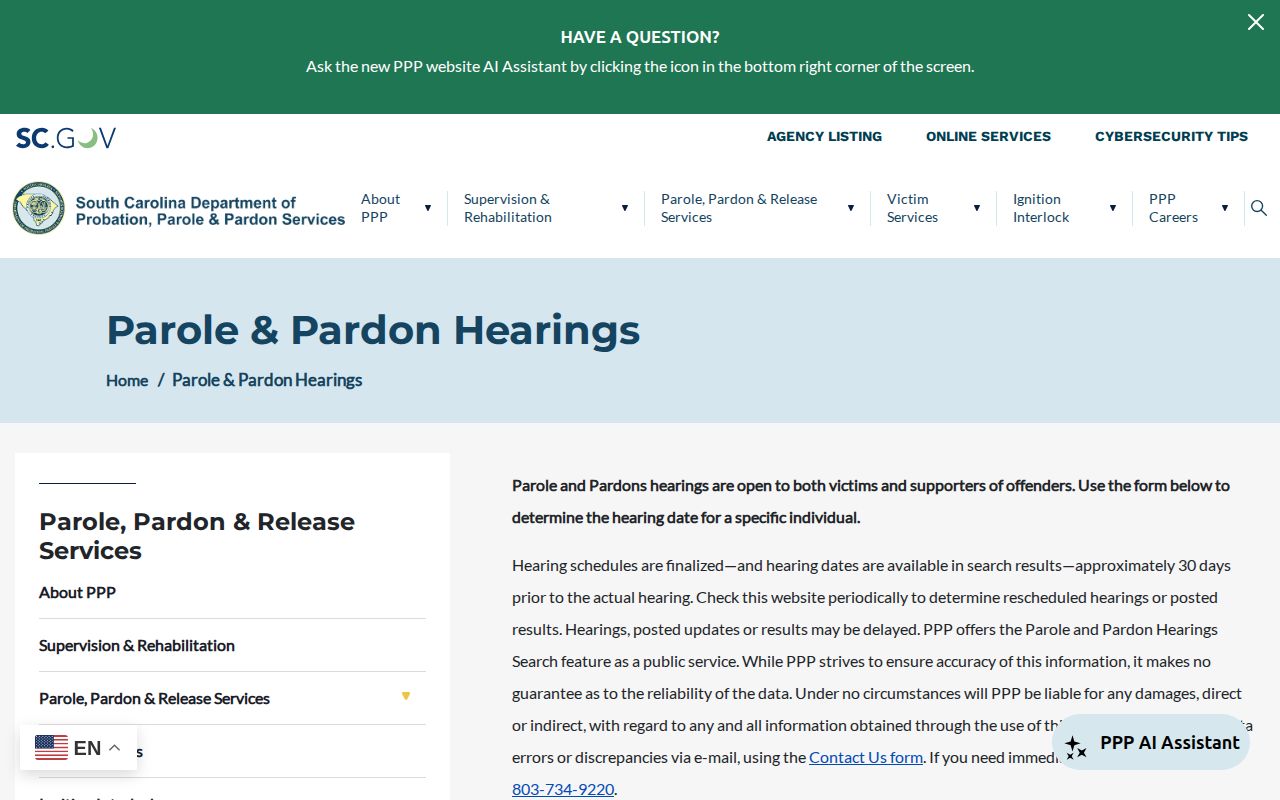
The search result supplies hearing context. The SCDPPPS hearing FAQ addresses recurring eligibility and scheduling questions, while SCDC and SCDPPPS must still confirm release and active supervision.
Saluda Supervision Status Changes
Community supervision may include lawful rules on reporting, travel, treatment, restitution, and conduct. The Board's parole consideration criteria provide official context for conditional decisions. The exact terms come from the order or agency record. A violation allegation may lead to a hearing, changed terms, a warrant, or revocation. Revocation means a decision that supervision should be withdrawn or altered, often with a return to custody. It should not be inferred from a missed appointment or an old address.
An absconder status generally alleges that a person stopped required contact or compliance. It is not the same as an unconditional release. No public Saluda County Sheriff absconder or warrant list was found in the official research. Check the applicable SCDPPPS public record and the court docket. If a warrant must be confirmed, use the office that issued or holds it.
SC VINE can report covered custody or supervision changes, but it is not a permanent certified record. A transfer can require a new registration. The state system covers participating county detention centers, SCDC, and SCDPPPS, while a federal custody question belongs with the Bureau of Prisons. These boundaries prevent a move between systems from being mistaken for final discharge.
Note: Status words carry legal weight, so preserve the agency’s exact label rather than translating every community category into parole or probation.
Saluda Post-Release Reentry Path
Saluda’s local reentry landscape begins with the named PPP office, not an anonymous statewide referral. SCDPPPS publishes an official explanation of parole for the move from Board action toward supervised release. A person leaving SCDC under supervision should confirm the assigned office and instructions with SCDPPPS. A person leaving the county jail should first determine whether any probation order exists. Short county custody alone does not create a PPP case.
Different offices preserve different parts of the trail. The Saluda Clerk or sentencing court holds the probation order. SCDC records show prison custody and the release type. The Board records a parole outcome. SCDPPPS documents community supervision. Keeping those sources separate makes it possible to tell whether a person was merely released from a building, entered a new supervision category, or reached final discharge.
Title 24, Chapter 21 is the state-law framework for parole, probation, and community supervision. Section 24-21-560 addresses a statutory community-supervision period for certain no-parole offenses. The current text is available through the South Carolina Legislature. Eligibility and duration still depend on the actual judgment and agency record.
Mail After Saluda County Release
Saluda County has an unusual post-release document process. Its official inmate-mail policy allows a former inmate to request digital copies of scanned mail from the assistant jail administrator. The request identifies the Saluda County Detention Center, the inmate name, inmate ID number, and the recipient email address. After identity verification, the recipient receives a download link.
This route helps recover correspondence after custody ends. It is not proof of the legal release time, supervision status, or final discharge. Those facts still come from the jail, SCDC, court, or SCDPPPS record. The distinction matters because a practical post-release service can exist even when correctional obligations continue.
Use the Saluda County inmate-mail policy for the required request details. The published facility contacts identify Assistant Jail Administrator Lorine Kelly at l.kelly@saludacounty.sc.gov. Personnel may change, so confirm the current contact before sending sensitive identity details.
Confirm Saluda Supervision Discharge
Release and discharge are not synonyms. Release can mean leaving the Saluda County Detention Center, departing SCDC, or moving into community supervision. Discharge is the formal end of the particular custody or supervision obligation. A person may have left prison yet remain under SCDPPPS rules. Another person may finish probation but still have an unresolved case entry or separate authority.
Confirm the end point with the agency that owned the term. Ask SCDPPPS for the public record or status that shows supervision ended. Use SCDC for the prison release event. Use the sentencing court for a probation order or later court action. The Saluda County Clerk of Court is the local contact for General Sessions records. If a record is incomplete, request the existing document rather than asking an office to create a new explanation.
A clean verification trail keeps the identity, category, agency, event date, and source together. Save the displayed update date. Then check any conflict with the originating office. That process distinguishes a stale online result from a true change and avoids treating release from one system as freedom from every other authority.
Note: Final discharge should be tied to a dated agency record, not inferred from silence in a public search tool.