
Federal Bureau of Prisons Releases
The Federal Bureau of Prisons, or BOP, holds sentenced federal prisoners and publishes a lasting public locator. A Saluda County resident or a person first encountered locally may enter the federal system through a federal charge, warrant, or transfer. That does not make the Saluda County Detention Center a federal prison. It also does not mean that a person prosecuted federally will appear in SCDC.
A typical path may run from arrest to temporary detention, U.S. Marshals custody, designation to a BOP institution, and eventual BOP release. The person may then enter federal supervised release, a court-ordered period in the community. Each stage has its own custodian. The BOP locator answers the prison-custody part of that path. The federal docket explains the legal basis, while supervision records address later conditions.
No BOP institution was identified within Saluda County in the official inventories reviewed. Geography should not be guessed. Federal prisoners can be assigned to institutions outside South Carolina, and a Saluda connection does not identify where a sentence was served. The South Carolina Department of Corrections and the South Carolina Department of Probation, Parole and Pardon Services are state channels, not BOP custodians. Search the national record by identity or federal number.
Search Federal Bureau Release Records
The official BOP Inmate Locator covers federal inmates from 1982 forward and offers two search routes. The number route accepts a BOP register number, DCDC number, FBI number, or INS number. The name route accepts first, middle, and last name, with age, race, and sex refinements. A known register number is the strongest way to separate similar names. Results can show name, register number, age, race, sex, release date, and location or status. Read the whole row. A past date and RELEASED label answer a different question from a future date and named institution.
- Choose the number search when a BOP, DCDC, FBI, or INS identifier is available.
- Otherwise enter the full name and use age, race, and sex only to refine likely matches.
- Compare the register number and identity fields before relying on any release date or status.
- Copy the exact status, displayed date, and location context without rewording the agency label.
- Check the federal docket or responsible agency when the locator does not explain a transfer or later custody.
The BOP image below shows the official historical custody and release-search interface. Source: Federal Bureau of Prisons Inmate Locator.
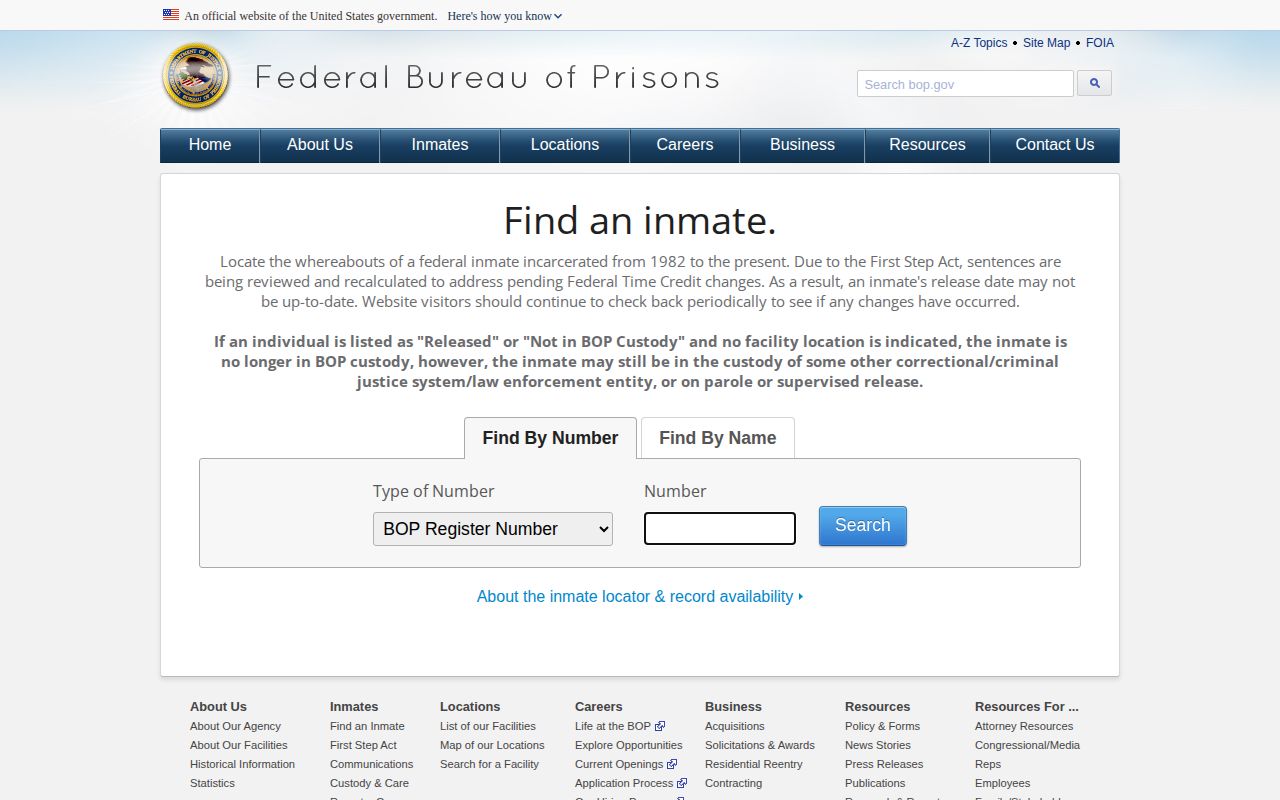
The national interface is the right starting point for a BOP sentence, regardless of where the person lived or where the federal case began.
Note: For custody before 1982, the public BOP locator may not supply the historical record, and archival research may be required.
Saluda Federal Release Status Labels
BOP’s labels have narrow meanings. RELEASED means the person is no longer in BOP custody. “Not in BOP Custody” also means the person is outside BOP, but the agency warns that another justice system may hold the person or that parole or supervised release may apply. A past release date with no institution marks the endpoint of the BOP portion of the trail.
IN TRANSIT is not release. It can describe movement involving the U.S. Marshals Service, and the person may remain fully confined during that movement. UNKNOWN means the confinement term is not determined. Neither label supplies a community-release date. Contact or docket research is needed when the locator cannot resolve the current federal stage.
| BOP display | What it means | What to check next |
|---|---|---|
| RELEASED | The person is no longer in BOP custody. | Federal docket and any supervision or later-custody record |
| Not in BOP Custody | The person is outside BOP, without a promise about other authorities. | Last known jail, court, USMS, ICE, or supervision source |
| IN TRANSIT | The person remains in federal movement or temporary custody. | Federal docket, counsel, court, or USMS channel |
| UNKNOWN | The confinement term is not determined. | Federal sentencing and custody records |
| Future release date | A projected federal date under the current BOP record. | Later BOP updates and the final release event |
Absence from BOP is never a complete all-systems search. Someone could be in the Saluda County jail, SCDC, another state system, ICE custody, or a non-BOP federal stage. The Saluda County released-inmate search path separates these authorities and identifies the correct local or state follow-up.
Saluda Federal Projected Release Dates
A future date in the BOP locator is projected. It may move as the agency applies the sentence, custody credit, statutory rules, and later recalculations. The First Step Act can affect federal time-credit calculations for eligible people. A displayed date should therefore be saved with the status and the date it was checked, not treated as an unchangeable promise.
The BOP projection is not a Saluda County jail calculation and not an SCDC projected release date. Those systems apply their own records and governing law. If the person is only in federal pretrial custody, a final BOP sentence computation may not yet exist. The federal court docket should show whether a sentence was imposed and can identify later orders that affect the term.
Release date and release destination are also distinct. Completion of BOP custody may lead to the community, a residential reentry stage, federal supervised release, or transfer to another authority. A detainer is a request or legal basis through which another agency may take custody. The BOP row alone may not explain that next step.
For a broader explanation of projections versus completed release events, use the Saluda County Release Date Lookup. Federal dates must still be confirmed through BOP and the federal case record.
Saluda USMS Custody Records
The U.S. Marshals Service manages many federal prisoners while they await proceedings, placement, or movement. Its Prisoner Tracking System records processing, confinement placement, safekeeping, and disposition, but it is internal rather than a public name locator. During federal pretrial custody, use the federal court docket and counsel or court channels for the legal status. The official USMS prisoner information explains the agency’s role. After BOP designation, the public locator may show an institution or status. Timing between those stages can produce an incomplete-looking result without any release.
A person could also be housed temporarily in a contract jail. If the last known stop was the Saluda County Detention Center, ask whether the person remained in local custody or was transferred to federal authority. The official Sheriff page names Sheriff Josh Price as of the research capture, but the Sheriff and jail can confirm only the local custody stage. The facility’s departure entry does not establish the later BOP release.
The Saluda state-court Public Index concerns South Carolina cases, not a substitute federal docket. Still, it can help rule in or explain a separate local case. The Saluda Public Index and the Saluda County Clerk of Court are relevant only for the local court trail.
Note: An IN TRANSIT result can reflect federal movement under USMS authority and must never be described as release to the community.
Federal Release Records and Contact
The locator is the first public contact point for a federal custody endpoint. BOP’s official explanation notes that “Not in BOP Custody” does not settle whether another authority holds the person. When the search result is unclear, identify the last known stage and ask the office responsible for that stage. A federal docket can document sentencing and later orders. BOP holds its own custody record. USMS manages pretrial movement, and a supervision office handles post-release conditions.
A focused inquiry should include the exact name, register number, date range, and the specific record sought. Ask for an existing custody or release record rather than a new narrative. For a pre-1982 federal history, the research points to the National Archives because the public locator’s coverage begins in 1982. For a current or later BOP record, use the agency’s official locator and information channels.
Federal Bureau of Prisons systemNational custody and release locator
Coverage: 1982 forward
BOP Inmate Locator
BOP locator explanation
No Saluda County BOP address or local BOP release desk exists in the research because no BOP prison was identified in the county. Directing a federal inquiry to the county jail can resolve only a local booking or transfer, not the later national prison record.
ICE Detainers After Saluda Release
Federal criminal custody and civil immigration custody are separate, but a release trail can cross both. If Saluda County releases someone on an ICE detainer, the person may remain held for up to 48 hours so ICE can assume custody under the applicable process. That county departure is a transfer, not proof that the person returned to the community.
ICE’s public locator covers current detainees and, according to ICE, people released from ICE custody within roughly the last 60 days. It is a short-window follow-up rather than a permanent archive. The preferred search uses a nine-digit A-number and country of birth. A biographical route uses name, date of birth, and country. The system does not accept searches for people under 18.
Use the ICE Online Detainee Locator System only when an immigration handoff is plausible. ICE also publishes its Detention Reporting and Information Line at 1-888-351-4024, open Monday through Friday except federal holidays from 8 a.m. to 8 p.m. Eastern. Interpreters are available. No ICE detention center was identified in Saluda County.
The distinction protects the accuracy of every federal release check. RELEASED from BOP, released by the county jail, and released from ICE are three different events. Match each event to the agency that created it, then check whether another custodian immediately followed.